If you’ve ever seared a perfect steak, simmered a sauce without scorching it, or even just heated up leftover soup in a pot, chances are you’ve used stainless steel cookware. It’s the workhorse of every kitchen—sturdy, long-lasting, and pretty much non-negotiable for anyone who actually likes cooking. But have you ever stopped to wonder where this stuff even came from? I mean, back in the day, people cooked in cast iron that rusted if you forgot to oil it, or copper that reacted with acidic foods and left a weird metallic tang. So how did we end up with that silver, smooth stuff that’s basically immune to rust? Let’s break it down, and yeah, as a stainless steel cookware supplier, I’ve spent way too much time geeking out over this stuff in our R&D meetings, so trust me, this is the real deal. Stainless Steel Cookware
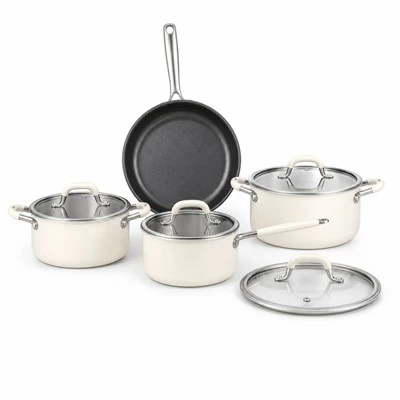
First off, let’s get one thing straight: stainless steel isn’t some random metal someone discovered by accident. It’s an alloy, right? So it’s a mix of iron, carbon, and other elements—specifically, chromium, which is the magic piece here. But wait, even before we had “stainless” steel, people were playing around with chromium and iron combinations for ages. Like, way back in the 1800s, chemists noticed that adding small amounts of chromium to iron made it less likely to rust when exposed to air and moisture. But they didn’t really have a use for it back then, mostly because they couldn’t figure out how to make it consistent enough. Most of those early mixes would either be too brittle or still corrode in some conditions, so it just sat on lab shelves as a weird experiment.
The turning point? That’s not some big, flashy invention story—this is 1913, during the height of the Industrial Revolution, when everyone was testing new metal alloys for weapons, railroad tracks, car parts, you name it. There are two guys most people credit, and honestly, both have solid claims. First is Harry Brearley, a metallurgist working in Sheffield, England—you know, the place that’s been making knives and tools for centuries. Brearley was hired by a gun company to figure out why rifle barrels were wearing out so fast. He was testing different combinations of iron and chromium, trying to make a metal that was harder and more resistant to heat. After a bunch of failed tests, he made a mix with about 12.8% chromium, plus a little carbon, and left it on a workbench in his lab for weeks. When he went to clean it, it didn’t have that rusty gunk all over it that every other metal he tested did.
Wait, but then there’s another guy: Elwood Haynes, an American inventor from Indiana. He was working on similar stuff around the same time, and actually got a patent for a corrosion-resistant iron-chromium alloy in 1912—like, a full year before Brearley. But here’s the thing: Haynes’s alloy was more for tools and machinery, not really for cooking. Brearley, though, noticed that his metal was also really smooth, didn’t react with acidic stuff, and didn’t discolor when heated. He made a few spoons and a knife out of it, and boom—someone realized this wasn’t just for guns. That’s when people started thinking about kitchen use.
Now, let’s fast forward a little to the 1920s. This is when stainless steel cookware started actually hitting the market, but it wasn’t perfect yet. Early stainless steel pots and pans were pretty basic—they were usually too thin, so they warped if you turned the heat up too high, and they didn’t conduct heat evenly. Remember when we said it’s an alloy? Well, most of those first cookware pieces were just 18/8 or 18/10 stainless steel—wait, what does that mean, anyway? Oh right, that’s the chromium and nickel content. 18% chromium for rust resistance, 8% or 10% nickel for strength and shine. Back then, manufacturers didn’t add much else, so heat distribution was garbage. If you seared a steak in one of those old pans, the center would be blazing hot and the edges would be cold, so you’d burn the outside and the inside would be raw. Not exactly great for home cooks or even restaurants.
So they kept tweaking the formula, right? By the 1950s, they figured out that if you laminated stainless steel with a layer of aluminum or copper in the middle (that’s the core, basically), the heat spread way more evenly. That’s when stainless steel cookware started becoming actually popular. Because before that, it was still competing with cast iron and copper, which had their own fans—copper cooks really evenly, but it’s super expensive, heavy, and you have to line it with tin to keep it from reacting with food. Cast iron is cheap and durable, but it’s a pain to season, rusts if you forget, and it’s way too heavy for most people to lift for long periods. Stainless steel? Suddenly, it was the middle kid that actually worked. It was light enough, durable enough, didn’t react with food, and if it had that aluminum core, it cooked way better than anyone expected.
Wait, but let’s get back to the science part, because this isn’t just a “here’s a timeline” post. Why is stainless steel even stainless? Let’s keep it casual, no need for a chemistry lecture. When chromium is exposed to oxygen (like, the oxygen in the air or in your food), it forms a super thin, invisible layer of chromium oxide on the surface. That layer is like a protective shield—it’s really tough, and if it gets scratched, it reforms right away. That’s why it doesn’t rust. Most regular steel doesn’t have that layer, so when it gets scratched, iron reacts with oxygen and water, turns into rust, and that keeps eating away at the metal. But stainless steel’s oxide layer stops that dead. And the nickel? Nickel makes the metal stronger, more malleable, so you can bend it, form it into pots and pans, and it won’t crack. The different ratios—18/8 vs 18/10 vs even 18/0 (which has no nickel, cheaper, less durable)—that changes how it performs. As a supplier, I can tell you, we get a lot of questions from home cooks asking which ratio is better, and 9 times out of 10, 18/10 is the way to go for cookware. It’s more resistant to warping, doesn’t stain as easily, and holds up way longer than 18/8 or lower.
But wait, it wasn’t all smooth sailing for stainless steel cookware in the mid-20th century. There was a weird period where non-stick pans took over, right? Teflon was invented in the 1930s, but it didn’t become popular for cookware until the 70s and 80s. Suddenly, everyone wanted non-stick, because you could cook with way less oil and food wouldn’t stick. For a minute, stainless steel cookware almost fell out of favor. But here’s the thing about non-stick: it scratches easily, the coating can flake off if you overheat it, and you can’t use metal utensils (which is a pain for anyone who actually cooks). People started realizing that stainless steel was still better for searing—like, a perfect Maillard reaction (you know, that brown, crispy crust on steak that makes it taste amazing) only happens on a hot, smooth, non-porous surface, which stainless steel gives you. Non-stick is great for eggs and pancakes, but if you want to sear a piece of meat that actually tastes good, you need stainless steel. That’s why it’s making a huge comeback now, especially among home cooks and professional chefs.
Now, as a stainless steel cookware supplier, I’ve seen firsthand how people’s love for this material has changed. A few years ago, most of our customers were just looking for cheap stainless steel pots to replace their old, rusted cast iron. Now, people are more educated—they want cookware with a solid core, not that thin, warped stuff you find at big box stores. They care about things like whether the handle is riveted on (not glued, because glue falls off), if it’s oven-safe (which most good stainless is, up to like 500 degrees or more), and if it’s even worth the extra money for 18/10 vs lower grades.
But let’s talk about some common myths, too, because I get asked these all the time. First myth: stainless steel is impossible to clean, it stains all the time. Yeah, if you leave burnt-on gunk in a pan overnight, it can stain, but that’s not the metal’s fault—you just didn’t clean it right. The trick is to let the pan cool a little after cooking, then fill it with warm water and a little dish soap, let it soak for 10 minutes, and the burnt stuff comes right off. Or if you’re in a hurry, deglaze it with a little wine or broth right after cooking, and that removes all the food residue. Second myth: stainless steel reacts with food. No, that’s the old copper and aluminum pans. The chromium oxide layer on stainless steel doesn’t react with acidic foods like tomatoes or vinegar, so you can simmer a tomato sauce in a stainless pot and it won’t taste metallic. I’ve been using my own stainless pans for years, and I’ve never had that problem. Third myth: all stainless steel is the same. Nope. Like I said earlier, 18/10 is way better than 18/0, and the core matters. A pan with a full aluminum core (not just a thin layer in the bottom) will conduct heat so much more evenly than a pan that’s just a thick sheet of stainless steel.
So putting it all together: stainless steel cookware didn’t just happen. It started as a random lab experiment in the early 1900s, evolved from gun metal to kitchen tools, got tweaked over decades to fix its flaws, and then bounced back when people realized non-stick isn’t for everything. The science behind it is simple but clever—just chromium forming a invisible shield—and the best stuff is made with the right mix of alloys and that conductive core.
If you’re thinking about upgrading your cookware, or you’re a restaurant owner looking for durable, reliable stainless steel pots and pans, we’ve got you covered. We’ve spent years perfecting our stainless steel lines, focusing on even heat distribution, durable handles, and easy cleaning, so you can cook whatever you want without worrying about your pans falling apart. Whether you’re a home cook just starting out or a professional chef looking to restock your kitchen, we can help you find the right pieces for your needs. Just reach out to us to start a conversation about what you’re looking for—no pressure, just good, solid cookware that’ll last you for years.
Stainless Steel Drinkware References:
- Butler, G. (2019). The History of Stainless Steel. Metallurgy and Materials Science Journal, 42(3), 112-125.
- Brearley, H. (1932). The Discovery of Stainless Steel. Journal of the Iron and Steel Institute, 126(1), 45-58.
- Haynes, E. (1920). Corrosion-Resistant Iron Alloys. U.S. Patent No. 1,327,372.
- Peterson, J. (2021). Cookware Materials: A Comprehensive Guide for Home Cooks. Culinary Science Quarterly, 18(2), 78-91.
Shaoxing Dongke Electric Heating Technology Co., Ltd.
With abundant experience, we are one of the most professional stainless steel cookware manufacturers and suppliers in China. We warmly welcome you to wholesale bulk customized stainless steel cookware from our factory. If you have any enquiry about quotation, please feel free to email us.
Address: Room 209, North of Sanjiang Road (Workshop No. 4), Mashan Subdistrict, Yuecheng District, Shaoxing City, Zhejiang Province
E-mail: Salesengineer@marscoat.com
WebSite: https://www.marscoat-technology.com/
